For India’s delivery riders, range anxiety isn’t about running out of charge on a highway. It’s about waiting 15 minutes at a swap station during lunch rush when orders are piling up. It’s about reaching a station at 7 PM to find all batteries depleted. It’s about the 45 minutes lost each day that could have been three deliveries, ₹150 in earnings, and the difference between meeting the day’s target or falling short.
As India’s gig workforce explodes and electric two-wheelers flood the streets, we’re discovering a truth the traditional EV conversation missed: for platform workers, vehicle downtime isn’t an inconvenience. It’s an income crisis.
The Hidden Bottleneck: Time, Not Tech
India’s platform economy is experiencing unprecedented growth. The gig and platform workforce stood at 7.7 million workers in 2020–21 and is projected to surge to 23.5 million by 2029–30, according to NITI Aayog. These aren’t weekend side-hustlers. These are professionals whose livelihoods depend on maximizing productive hours on the road.
Simultaneously, electric two-wheeler adoption is accelerating. Registrations hit approximately 11.5 lakh in FY 2024–25, marking a 21.2% year-on-year increase based on VAHAN data cited by SIAM. A significant portion of these vehicles are entering commercial fleets, piloted by delivery riders, logistics partners, and urban mobility providers.
The math is simple but brutal: every minute a gig worker’s vehicle isn’t moving is a minute they’re not earning. Traditional vehicle refueling takes 3–5 minutes. Home charging isn’t viable when you’re working 10–12 hour shifts across a city. Battery swapping promised to be the answer, but it’s revealing its own set of friction points.
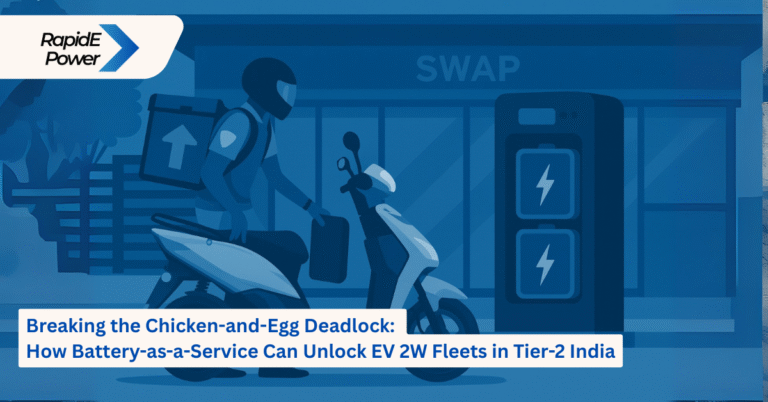
Consider a typical day for Ramesh, a Bangalore-based food delivery rider. His shift runs 11 AM to 11 PM with peak hours during lunch (12–2 PM) and dinner (7–10 PM). He needs three battery swaps during this window. But those same peak hours are when every other rider also needs a swap. The result: queue times stretch from the promised two minutes to 10–15 minutes. His third swap at 8 PM finds the station’s inventory depleted, forcing a detour to another location 2 kilometers away.
His downtime for the day: 47 minutes. His lost income: approximately ₹180–240 based on average delivery earnings.
Multiply this across hundreds of thousands of gig riders, and you’re looking at a systemic productivity leak that undermines both the EV transition and livelihood security.
Why “More Swap Points” Alone Won’t Fix It
The intuitive response is infrastructure expansion. More swap stations mean shorter distances, reduced congestion, better access. And yes, network density matters. But it doesn’t solve the core operational challenge: demand concentration and inventory imbalance.
✅ The Peak-Hour Crunch: Gig work isn’t evenly distributed throughout the day. Food delivery, e-commerce logistics, and ride-hailing all experience dramatic demand spikes during predictable windows. When 60% of your riders need energy between 7–9 PM, even a dense network of swap points hits capacity limits. Queues form. Wait times spike. Riders lose money.
✅ The Inventory Puzzle: Battery swapping requires constant inventory rebalancing. A swap station in a commercial district might exhaust its charged batteries by 2 PM while suburban stations sit with surplus inventory. Without real-time redistribution logistics or predictive demand management, utilization becomes uneven. Riders either wait for depleted batteries to charge on-site (defeating the speed advantage of swapping) or travel farther to find available inventory (adding downtime and reducing the effective density of your network).
✅ Operational Friction: Current swap ecosystems often operate on a first-come, first-served basis with limited reservation capabilities. Riders don’t know station availability until they arrive. Battery health varies, affecting range and performance. Payment friction, app issues, or hardware malfunctions add unpredictable delays. Each of these small frictions compounds into hours of lost productivity across a fleet.
✅ Infrastructure alone can’t solve a coordination problem: You need an operations model that treats energy delivery as a service with reliability guarantees, not just a commodity transaction at a physical location.
Battery-as-a-Service as an Operations Model

This is where battery subscription fundamentally changes the equation. It’s not about ownership versus rental. It’s about shifting from transactional energy access to guaranteed energy availability.
✅ The SLA (Service Level Agreement) Mindset
Battery-as-a-Service (BaaS) providers operate with service-level agreements that traditional infrastructure doesn’t. The rider isn’t buying a battery or even a swap. They’re subscribing to energy uptime. The provider commits to:
- Availability guarantees: Charged batteries when and where the rider needs them, backed by demand forecasting and dynamic inventory management
- Battery health assurance: Consistent range and performance through systematic rotation and maintenance
- Turnaround time targets: Maximum wait time commitments, often with alternative fulfillment options if targets are breached
This SLA approach transforms the provider’s operational incentives. Revenue now depends on minimizing rider downtime, not just maximizing transaction volume. Poor battery health, inadequate inventory, or network congestion become the provider’s problem to solve, not the rider’s frustration to endure.
What Changes for the Rider
From the gig worker’s perspective, the shift is tangible:
Predictable energy costs replace variable charging or swap expenses, simplifying budgeting and improving income certainty. Riders know exactly what they’ll spend on energy each month regardless of surge pricing or seasonal demand fluctuations.
Reduced dead-hours through priority access protocols, reservation systems, and proactive availability notifications. Instead of gambling on whether a swap station will have inventory, riders receive real-time updates and guaranteed slots during their highest-earning hours.
Fleet-grade reliability brings commercial vehicle standards to individual gig workers. Battery health monitoring, preventive maintenance alerts, and systematic replacement cycles ensure consistent performance. Range doesn’t degrade unpredictably. Planning becomes possible.
Operational visibility through integrated apps that show not just station locations but predicted availability, estimated wait times, battery health ratings, and alternative fulfillment options. Riders make informed decisions instead of hoping for the best.
The economic impact is direct: fewer minutes wasted per shift translates to more deliveries completed, higher platform ratings, better incentive earnings, and improved daily income stability.
What Policymakers Are Indirectly Pushing

India’s EV policy framework has largely focused on vehicle subsidies, manufacturing incentives, and charging infrastructure targets. But as gig workforce growth intersects with EV adoption acceleration, a new policy dimension is emerging: energy reliability as a livelihoods issue.
✅ Gig Growth + EV Growth = Productivity Imperative
When 23.5 million workers depend on vehicle uptime for their income and millions of those vehicles are electric, energy access becomes labor market infrastructure. Gaps in energy availability don’t just inconvenience consumers, they threaten livelihood security for a rapidly expanding workforce segment that already faces income volatility and limited social protection.
State EV policies increasingly recognize this intersection. Recent frameworks in Delhi, Maharashtra, and Karnataka include specific provisions for commercial EV segments, acknowledging that gig and logistics fleets drive EV adoption volume and face distinct operational requirements. The push for battery swapping standards, interoperability mandates, and quality benchmarks reflects an understanding that fragmented, unreliable energy access undermines both electrification goals and platform economy productivity.
✅ The Unspoken Policy Goal
While not explicitly framed this way, policymakers are essentially creating conditions for energy-as-a-service models that deliver fleet-grade reliability to individual gig workers. Interoperability standards reduce lock-in risks. Safety and performance benchmarks raise quality floors. Support for swap infrastructure creates the physical network. But making that infrastructure operationally effective for gig livelihoods requires service models with availability guarantees and demand management capabilities.
Battery subscriptions, properly implemented, align with multiple policy objectives simultaneously: accelerating EV adoption in high-utilization commercial segments, improving platform worker productivity and income stability, reducing urban emissions through fleet electrification, and demonstrating scalable models for energy access that don’t depend on home charging infrastructure.
The RapidE Lens: Depot Charging + Subscription as System Fix
This is where RapidE’s approach becomes particularly relevant as a case study in addressing the gig energy problem systemically rather than incrementally.
How Depot Charging Smooths Peak-Hour Pressure
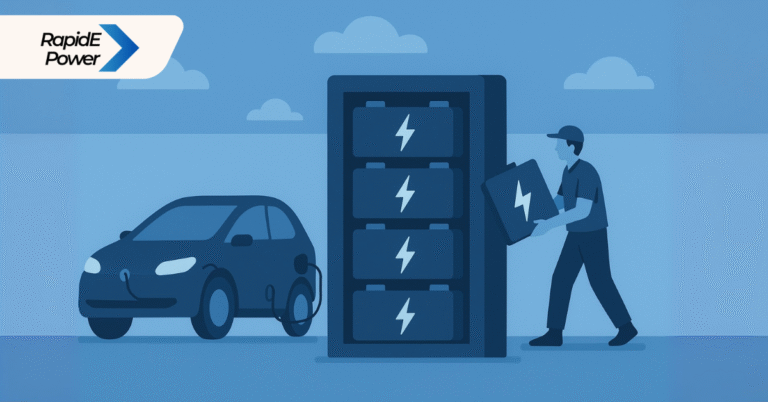
RapidE’s model combines centralized depot charging with battery subscription and swap network access. Instead of relying solely on distributed swap stations to charge batteries on-site, the bulk of charging happens at optimized depot facilities with grid management capabilities, time-of-use rate advantages, and systematic battery maintenance protocols.
This architectural choice has operational implications for gig riders:
✅ Peak-hour inventory doesn’t depend on on-site charging speeds. Swap stations become distribution points rather than charging bottlenecks. During the 7–9 PM dinner rush, stations can maintain inventory because depot operations have pre-charged adequate battery stock based on predicted demand patterns.
✅ Battery rotation becomes systematic. Depot charging enables regular cycling of batteries through health checks, firmware updates, and preventive maintenance without removing them from circulation unpredictably. Riders encounter consistent battery performance because the back-end operations ensure quality control.
✅ Demand forecasting gets better data. Subscription models generate usage pattern data that depot operations can use for predictive inventory positioning. If historical data shows a commercial district requires 200 batteries between 7–9 PM, depot logistics can pre-position inventory accordingly rather than reacting to real-time depletion.
Making the Transition Work
The shift to battery subscription models won’t happen uniformly or instantly. It requires coordination among multiple stakeholders—battery providers, vehicle OEMs, swap network operators, platform companies, and gig workers themselves. But the economic logic is increasingly clear.
For gig workers, subscriptions reduce income volatility, improve operational efficiency, and provide fleet-grade reliability without requiring large upfront investments or vehicle ownership commitments.
For platform companies, ensuring rider energy reliability reduces operational disruptions, improves service quality, and supports workforce retention in an increasingly competitive labor market.
For energy infrastructure providers, subscription models create predictable revenue streams, enable better demand management, and justify the operational investments required for high service-level performance.
For policymakers, supporting the transition addresses livelihood security, accelerates commercial EV adoption, and demonstrates inclusive electrification pathways that don’t depend on home charging access or high upfront costs.
The Bottom Line
The future of gig EVs isn’t about better batteries or faster swaps. It’s about guaranteed uptime. As India’s platform workforce grows to 23.5 million and electric two-wheelers become the default for urban mobility, energy access becomes productivity infrastructure.
Battery subscriptions, when backed by smart operations models like depot charging and demand management systems, transform energy from a transaction into a service—one that treats rider productivity as the metric that matters. The technology exists. The infrastructure is scaling. What’s needed now is the operational discipline to make energy access as reliable as the gig platforms riders depend on for their livelihoods.
Downtime isn’t just an inconvenience anymore. For millions of gig workers, it’s the difference between making a living and falling behind. The energy solution that wins won’t be the one with the most stations or the fastest swap. It will be the one that keeps riders moving, hour after hour, shift after shift, delivery after delivery.
Because in the gig economy, time isn’t money. Time is the job. And the energy model that protects that time will define the next phase of India’s EV transition.