Building a traditional EV charging station in India takes anywhere from three to nine months. You need load sanction approvals from distribution companies. Transformer upgrades if local grid capacity is insufficient. Permits from multiple municipal authorities. Civil works for foundation, cable trenching, and site preparation. Electrical contractor coordination. Safety inspections. Fire NOCs. And that’s assuming you can even secure a suitable location with grid access in the first place.
For last-mile fleet operators—delivery aggregators, logistics companies, e-rickshaw fleet managers—this timeline doesn’t align with business reality. Fleet electrification decisions happen in weeks, not quarters. Demand concentrates around commercial hubs, logistics parks, and high-traffic corridors where grid infrastructure is often already strained. Waiting six months for grid approvals means missing the window when fleet operators need energy infrastructure.
This is where modular energy storage systems (ESS) fundamentally change the deployment equation. When charging capacity comes packaged as stackable, transportable battery storage with integrated charging sockets, you’re no longer building grid-dependent infrastructure. You’re deploying energy itself.
Why Charging Infrastructure Is Slow to Build
The bottlenecks in traditional EV charging deployment aren’t primarily technical—they’re institutional and logistical.
Load Sanction and Grid Capacity
Installing a fixed charging station requires securing load sanction from the local electricity distribution company (DISCOM). The DISCOM must assess whether the existing grid infrastructure can support the additional electrical load you’re requesting. In many urban commercial areas and high-density logistics zones, local transformers are already operating near capacity. Adding even modest charging load (50-100 kW) can require transformer upgrades or feeder reinforcement.
The timeline for grid upgrades is measured in months, sometimes years, depending on budget cycles, equipment procurement lead times, and contractor availability. And that’s after your load sanction application is approved—a process that itself can take weeks to months depending on DISCOM workload and documentation requirements.
Permits, Clearances, and Municipal Coordination
Beyond electrical infrastructure, charging stations require multiple permits:
- Municipal building permits for any permanent structure or civil works
- Fire department NOCs (No Objection Certificates) for safety compliance
- Environmental clearances in certain zones or for larger installations
- Land use approvals if the site isn’t already designated for commercial electrical infrastructure
Each approval body operates on its own timeline with its own documentation requirements. Coordination across agencies adds delays. A missing document or incorrectly filled form can restart waiting periods.
Civil Works and Site Preparation
Traditional charging stations require substantial physical infrastructure:
- Foundation work for charging pillars and electrical equipment
- Cable trenching from the grid connection point to the charging site
- Weatherproofing and protective enclosures for electrical equipment
- Vehicle parking and access area preparation including markings, barriers, and lighting
- Security measures such as fencing, CCTV, and site lighting
These aren’t insurmountable challenges, but they add time, cost, and complexity to every deployment. For operators trying to match charging infrastructure to fast-moving fleet demand, this friction is prohibitive.
The Capital Lock-In Problem
All this lead time and infrastructure investment creates a capital lock-in problem. You commit significant upfront capital to a fixed location based on demand projections. If fleet patterns shift—a logistics hub relocates, a delivery aggregator changes service zones, traffic patterns evolve—your fixed infrastructure can’t adapt. The capital is sunk. The asset becomes stranded or underutilized.
This risk makes fleet operators conservative about where they commit to charging infrastructure, which in turn limits how quickly electrification can scale.
What “Deployable Storage + Sockets” Changes

Modular ESS flips the traditional infrastructure model. Instead of building grid-connected charging stations where load is needed, you deliver stored energy to the location and scale capacity by stacking units.
The Core Concept
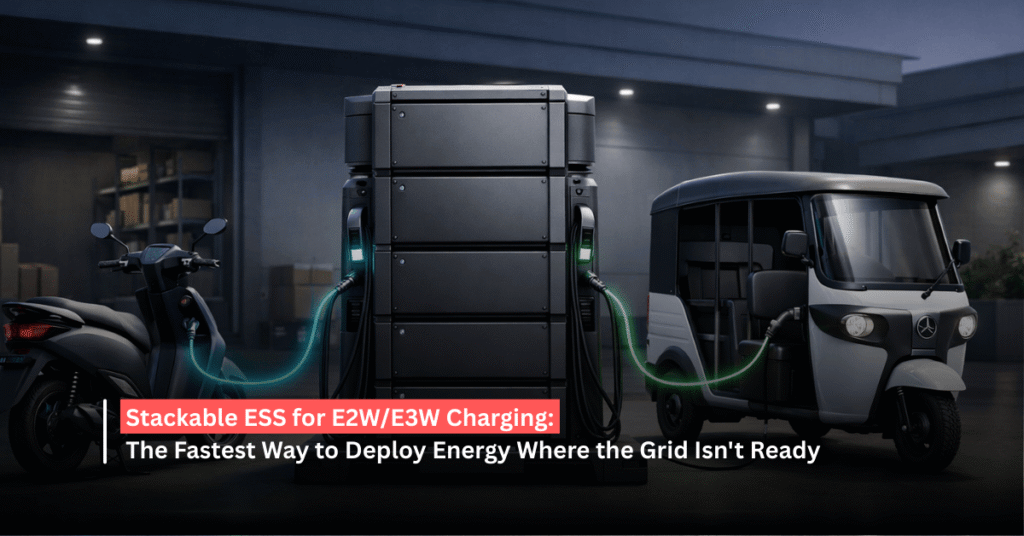
A stackable ESS is essentially a large-format battery system with integrated charging outputs and control electronics, packaged in a transportable form factor. Think of it as a shipping-container-scale power bank with EV charging sockets. Key characteristics:
➤ Modular capacity scaling: Each unit provides a defined energy capacity (typically 50-200 kWh per module). Need more charging capacity at a site? Stack additional units. Demand decreases? Redeploy units elsewhere.
➤ Grid-independent deployment: The ESS charges from the grid (or renewable sources) at a separate location where grid capacity exists, then gets transported to the demand site. Once on-site, it delivers energy without requiring local grid connection upgrades or load sanction approvals.
➤ Rapid deployment: Site requirements reduce to secure footprint, weather protection, and basic access. No trenching, no transformer work, no multi-month permit processes. Deployment time drops from months to days.
➤ Flexible redeployment: If demand shifts, physically move the ESS units to the new high-demand location. Capital follows demand dynamically instead of being locked into fixed locations.
What This Enables for E2W/E3W Fleet Charging
For electric two-wheeler and three-wheeler fleets, deployable ESS opens charging infrastructure possibilities that traditional models can’t match:
Micro-location charging hubs at dark stores, delivery aggregator parking zones, last-mile logistics centers, and high-demand commercial corridors without waiting for grid upgrades. Energy access materializes where fleets actually operate, not where grid infrastructure happens to be convenient.
Demand-responsive capacity that scales with fleet size. A fleet operator starting with 20 vehicles can deploy a single ESS unit. As the fleet grows to 50, then 100 vehicles, additional units stack in. Capital expenditure matches revenue-generating fleet expansion.
Seasonal and event-based deployment for temporary demand spikes. Festival season e-commerce deliveries, agricultural logistics during harvest, event-based mobility needs—deployable ESS can serve these without permanent infrastructure buildout.
Charging as a service at unconventional sites like wholesale markets, industrial estates, and peri-urban logistics zones where permanent charging stations face regulatory or economic barriers but where fleet demand concentrates.
Capacity Scaling by Stacking
The stackability principle is straightforward but operationally powerful. Each ESS unit is a discrete energy asset. Stacking them creates charging sites with additive capacity:
- 1 unit (100 kWh) supports ~20-25 E2W charging sessions per day or ~10-12 E3W sessions
- 2 units (200 kWh) double the site capacity without requiring additional grid connection
- 4 units (400 kWh) can serve a mid-size last-mile fleet of 60-80 vehicles daily
This modularity allows incremental capacity investment matched to validated demand, rather than committing to fixed infrastructure based on uncertain projections. Financial risk decreases. Deployment flexibility increases.
A Practical Deployment Blueprint

Deploying stackable ESS for fleet charging isn’t just about dropping battery units at locations. Effective deployment requires methodical site selection, operational planning, and performance tracking. Here’s a practical framework:
Site Selection Checklist
Not every location is a good candidate for ESS-based charging. Effective site selection evaluates:
➤ Fleet density and dwell time: How many vehicles operate in the catchment area? How long do they typically park or idle? E-rickshaw hubs with 30+ vehicles parking for 1-2 hours during shift breaks are ideal. Delivery zones where riders stop for 15-20 minutes between runs work well. Transient traffic corridors with no dwell time don’t.
➤ Footfall patterns and access: Is the location easily accessible for the target fleet? Are there competing energy access options nearby? Sites that become natural gathering points for fleet operators (near logistics hubs, aggregator offices, wholesale markets) have built-in demand.
➤ Security and supervision: ESS units contain valuable battery assets and need protection from theft, vandalism, or tampering. Sites with existing security (guarded parking areas, monitored logistics centers, gated commercial premises) reduce risk and supervision overhead.
➤ Weather protection and drainage: While ESS units are weatherproofed, prolonged exposure to extreme weather, waterlogging, or direct sun affects longevity and safety. Covered parking areas, loading bays, or locations with basic shelters are preferable.
➤ Charging infrastructure proximity: For charging the ESS units themselves, proximity to existing grid access or dedicated charging facilities matters. Can the units be easily transported to/from a charging depot? Is there a local grid connection suitable for slower off-peak ESS charging if on-site charging is viable?
➤ Regulatory and land-use compatibility: Does the site owner permit commercial charging operations? Are there local regulations about energy storage or commercial electrical equipment? While deployable ESS avoids many grid-related permits, basic site-use permissions still matter.
Daily Operations Model
Once deployed, stackable ESS sites require operational discipline to maintain availability and safety:
➤ Morning battery replacement or recharge cycles: Depleted ESS units are either swapped out for fully charged units from the depot, or if site conditions permit, recharged on-site during off-peak grid hours (typically late night to early morning). The key is ensuring full capacity availability before peak demand hours start.
➤ Inventory planning and demand forecasting: Operators track daily energy consumption patterns to predict how many ESS units are needed at each site. Historical data on sessions per day, average energy drawn per session, and peak-hour demand concentration inform deployment decisions.
➤ Safety SOPs and monitoring: Each site follows standard operating procedures for ESS safety, including thermal monitoring, state-of-charge tracking, emergency shutdown protocols, and periodic inspection schedules. Remote monitoring systems alert operators to anomalies—unusual temperature readings, voltage irregularities, or connectivity issues.
➤ User experience and payment integration: Fleet users need clear instructions, app-based station discovery, real-time availability updates, and seamless payment processing. The operational model must make charging from ESS-based stations as friction-free as traditional fixed infrastructure.
➤ Logistics coordination: For swap-based models where depleted units are replaced with charged ones, transportation logistics become critical. Efficient routing, vehicle availability, and timing coordination ensure sites don’t run out of capacity mid-day.
Simple KPI Set for Performance Tracking
Effective ESS deployment requires measurable performance indicators that track both utilization and service quality:
➤ kWh delivered per day: Total energy dispensed from the ESS to vehicles. This measures actual fleet energy demand at the site and validates whether deployment matches needs.
➤ Sessions per day: Number of individual charging transactions. Combined with kWh delivered, this reveals average energy per session, helping optimize ESS capacity sizing.
➤ Utilization rate: Percentage of available ESS capacity actually consumed daily. Low utilization suggests over-deployment or poor site selection. Consistently maxed utilization indicates capacity constraints and opportunity for additional unit stacking.
➤ Turnaround time: For swap-based models, how long does it take from ESS depletion to replacement with a charged unit? Longer turnaround means more units needed in circulation to maintain availability.
➤ Downtime incidents: Frequency and duration of service interruptions due to equipment failure, delayed swaps, or safety shutdowns. This tracks operational reliability—the metric fleet operators care about most.
➤ Cost per kWh delivered: Total operational costs (ESS charging, transportation, labor, maintenance) divided by kWh delivered. This reveals economic viability and guides pricing strategy.
These KPIs create a feedback loop that improves deployment decisions over time. Underperforming sites get redeployed. High-demand sites scale up. The infrastructure becomes adaptive rather than static.
Policy Alignment: Storage Is Becoming a System Requirement
India’s energy policy landscape is rapidly incorporating energy storage as a core infrastructure requirement, not an experimental technology. This policy evolution creates a supportive environment for deployable ESS applications.
Massive Storage Projections
The Institute for Energy Economics and Financial Analysis (IEEFA), citing Central Electricity Authority (CEA) estimates, projects India will need 411.4 GWh of energy storage capacity by 2031–32, with 236.2 GWh coming from battery energy storage systems (BESS). These aren’t aspirational targets—they’re infrastructure planning benchmarks driving policy and investment.
This scale of storage deployment reflects the recognition that India’s renewable energy expansion (particularly solar) requires grid-scale energy buffering to manage intermittency. But storage infrastructure isn’t just about grid stability—it creates opportunities for distributed energy applications including EV charging.
National Framework for Promoting Energy Storage Systems
The Ministry of Power has published the National Framework for Promoting Energy Storage Systems, establishing policy principles, regulatory pathways, and market structures for storage deployment across applications. This framework legitimizes energy storage as an infrastructure category with defined roles in grid management, renewable integration, and energy access.
For deployable ESS operators, this framework matters because it:
- Creates regulatory certainty about how energy storage systems are classified, permitted, and operated
- Establishes safety and technical standards that responsible operators can align with, differentiating serious infrastructure providers from ad-hoc deployments
- Signals policy support for storage applications beyond grid-scale projects, including distributed and mobile storage use cases
VGF Operational Guidelines for BESS
The Ministry of New and Renewable Energy (MNRE) has published Viability Gap Funding (VGF) operational guidelines for BESS, creating financial mechanisms to support storage deployment where economic viability needs policy assistance. While VGF primarily targets grid-scale projects, the existence of structured financial support signals government commitment to making storage economically viable.
For private operators deploying ESS for EV charging, this doesn’t directly provide funding access, but it validates the infrastructure category and demonstrates that storage is being treated as critical infrastructure deserving policy support.
EV Charging Infrastructure and Storage Integration
PM E-DRIVE’s operational guidelines for EV public charging stations, while primarily focused on grid-connected charging, acknowledge the broader energy infrastructure ecosystem including storage integration. As charging standards and operational guidelines evolve, the policy framework increasingly recognizes that charging infrastructure doesn’t necessarily mean fixed grid-connected stations—it means reliable energy access delivered through whatever combination of grid, storage, and distribution makes operational sense.
This policy flexibility is crucial for deployable ESS models. As long as charging operations meet safety standards, technical specifications, and user experience benchmarks, the policy framework doesn’t mandate a single infrastructure archetype.
India’s E2W and E3W electrification is moving faster than the grid can adapt. Fleet operators are making decisions in weeks, while traditional charging infrastructure still moves on timelines measured in months. That gap is no longer theoretical—it’s operational.
Stackable, modular ESS changes the equation by separating energy deployment from grid readiness. Instead of waiting for approvals, upgrades, and permanent build-outs, operators can place charging capacity exactly where demand exists, scale it incrementally, and relocate it as fleet patterns evolve. Energy becomes deployable infrastructure, not a fixed asset tied to a single location.
This model doesn’t replace grid-connected charging. It complements it. Fixed infrastructure works where demand is stable and grid capacity is available. Deployable ESS works where demand is emerging, shifting, or time-critical. Together, they form a charging ecosystem that matches how last-mile logistics actually operates.
For E2W and E3W fleets, the real constraint isn’t vehicle availability or battery technology. It’s time to deployment. The solutions that win won’t be the ones that look best on policy roadmaps, but the ones that get energy on the ground fast, scale with demand, and move when the business moves.
That’s the role stackable ESS is beginning to play—not as a workaround, but as a necessary layer in India’s EV charging stack.